
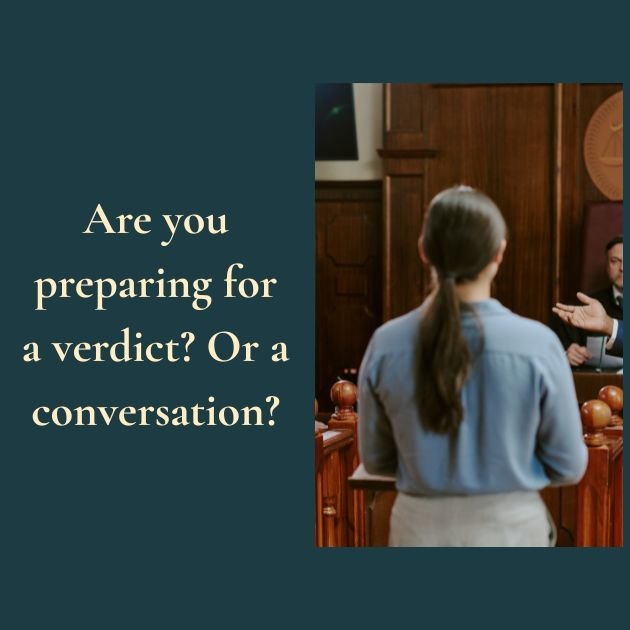
You are confident about what the work does and does not show. Your team has spent months on it. You have been through the analysis, asked the questions you always ask, pushed back on the parts that needed pushing back on, and you know it to be sound. You know which way the findings point and you know why the alternative readings do not hold. Not that you would ever withhold those alternative readings; they are in the back-up slides.
And you have a very ambitious but do-able future strategy in the final slides.
Then, somewhere around the third slide, the VP asks a question and does not look convinced.
He does not say why. He rarely does. He asks it in the tone of a man who has been unconvinced in a great many meetings and has found it to be a reliable position. He has a reputation. And you hear yourself saying that it is a good question, that of course these are early findings, that there are other ways to read it, that you would be happy to take it back and look again before anyone draws firm conclusions.
None of which you believe.
Go back into that room. Before he speaks.
You are on the second slide. Nothing has gone wrong yet. Nobody has challenged anything. And your heart is already going. Not fluttering, going, hard enough that you are aware of it, the way you are aware of a machine running in the next room. Your breath has gone shallow and stayed there, high in the chest, and you have not noticed because you are talking. There is a sound in your ears that is not quite a sound. Your shoulders have come up an inch. And underneath all of it there is a bracing, a leaning forward into the next few seconds, waiting to find out which way the room is going to go.
You are not nervous about the data. The data are fine. You checked it.
What your body is doing is preparing for a verdict.
All of that is in place before the VP says anything. The bracing is not a response to being challenged; it is already there, waiting, from the moment you begin to speak. He does not create it. You are already right there.
Which means the sentence you say afterwards, the one about it being early and there being other readings, does not begin when he speaks. It has been in the wings while you monitor the room for how this is going to go for you.
It did not come from nowhere, and it is not a flaw in you. It is the product of two trainings, both of which run alongside each other.
The first is scientific. You were taught to hold your conclusions loosely, to state no more than the evidence supports, to treat certainty as the thing you earn last and give up first.
The second training you did not sign up for. Over a couple of decades in rooms like this one you have observed, accurately, that a woman who states a finding flat is heard differently from a man who does the same. You have watched it happen to colleagues and you have had it happen to you. You have seen what gets called confident in him and what gets called something else in you. Nobody taught you this in a course. You collected the data yourself, and the data were good.
These are both correct readings. And in the second slide they run together, faster than you can think, and what they produce is a tension and is in fact two well-trained systems doing exactly what they were supposed to do.
Afterwards you replay the meeting and go back over the slide deck, looking for the sentence where you went wrong. It is a reasonable place to look; something must have moved his uncertainty meter. Maybe it was this. Maybe it was that. And then a thought arrives from nowhere. Maybe it is just you.
This is why the preparation does not hold. You go in with better wording, firmer phrasing, a plan for what to say when he does it again, and the resolve melts away by the second slide, because none of it is addressing the real reason why you are backing down. Better evidence does not touch the second training. Confidence coaching does not touch the first. You have been trying to fix half a problem, and the half you cannot see is the one holding it in place.
What is actually deciding is a subconscious that has already sized up the room and concluded this is a trial, you are already in threat mode. Not a meeting where findings are examined, a trial where you are the one being examined, and he is the one who will rule. And so you do what anyone does in front of a judge. You play to his ego. You concede a little to buy some goodwill. You water down a finding you know to be sound, and you walk out having quietly undersold four people who were not in the room, without ever making a decision to do it.
There is a version of this where the VP asks exactly the same question, in exactly the same tone, and you notice something like pleasure. Good, you think, we are going to spar. It sharpens you. It makes you clearer about what you are actually claiming and what you are not. You ask him what is not landing, because you want to know, and whatever comes back is information rather than a ruling. The findings stay where they are. The four people who are not in the room stay properly represented. And you leave the meeting with nothing to replay.
If you recognised yourself in any of this, that is enough for today. Nothing has to be done with it.
When something does need doing with it, there are two ways to reach me. Book fifteen minutes and tell me about your own version of that room, and I will tell you plainly whether this is work I can do with you. Or reply to this and tell me what you noticed, if fifteen minutes is more than you want to give a stranger.


0 Comments